
The Daily Standup: How Micro-Meetings Can Supercharge Small Team Productivity
- jeff wilson
- Jul 28, 2025
- 5 min read

The Meeting That's Only Valuable When Done Right
In a world where "meeting fatigue" has become a workplace epidemic, daily standups have a mixed reputation. When executed properly, these micro-meetings can be powerful tools for team coordination. When done poorly, they quickly become the recurring calendar event everyone secretly dreads.
But what exactly makes these brief gatherings effective when they work? And how can your team implement them without falling into the common traps that turn potentially productive sessions into time-wasting ceremonies?
What Is a Daily Standup (And Why Stand)?
A daily standup is a brief, focused meeting where team members literally stand (hence the name) and quickly share:
- What they accomplished yesterday
- What they plan to accomplish today
- Any blockers preventing progress
The genius lies in its simplicity. By physically standing, participants are naturally inclined to keep things brief—nobody wants to stand through a 45-minute discussion of technical details. The format encourages conciseness, relevance, and action.
Small teams benefit disproportionately from this approach. With fewer people involved, each team member gets adequate speaking time while keeping the overall meeting under 15 minutes. The intimacy of smaller groups also fosters psychological safety, encouraging honest discussions about challenges.

The Science Behind Micro-Meeting Magic
Contrary to conventional wisdom that "more meeting time equals more alignment," research suggests the opposite. Our brains are wired for focus in short bursts. The concentrated format of standups works with our natural attention spans rather than against them.
Harvard Business Review research shows that meeting effectiveness drops dramatically after 30 minutes, with the sharpest engagement occurring in the first 10-15 minutes. Daily standups capitalize on this peak attention window.
For small teams, these biological realities are even more relevant:
- Reduced context switching: Brief meetings minimize the cognitive toll of transitioning between deep work and collaboration
- Immediate relevance: When limited to current priorities, information retention improves by up to 40%
- Optimized cognitive load: Small teams discussing immediate concerns stay within working memory capacity
Core Components of an Effective Standup
The Three Questions Framework
The most effective standups revolve around three simple questions:
1. What did I accomplish yesterday? This creates accountability and celebrates progress, providing a natural dopamine boost that motivates continued achievement.
2. What will I accomplish today? Publicly stating intentions dramatically increases follow-through. Psychology studies show we're 65% more likely to complete tasks we've verbally committed to in front of peers.
3. What's blocking my progress? This transforms individual challenges into team problems, enabling rapid resource allocation and support.
The Timekeeper's Role
Effective standups require gentle but firm timekeeping. Small teams often rotate this responsibility, which builds empathy for the facilitator role and ensures everyone experiences both sides of the meeting dynamic.
When someone veers into detailed problem-solving, the timekeeper redirects with: "That sounds important. Let's schedule a separate discussion for those interested right after this meeting."

Small Team Advantages: Why Standups Work Better with Fewer People
Small teams (typically 3-9 members) experience unique benefits from daily standups:
1. Complete Visibility Without Information Overload
With fewer updates to process, each team member can maintain awareness of all workstreams without cognitive overload. This creates an environment where:
- Cross-functional assistance happens naturally
- Duplicate efforts are immediately identified
- Opportunities for collaboration become obvious
2. Faster Problem Resolution
Small teams can rapidly mobilize around blockers mentioned in standups. When a teammate mentions a roadblock, the intimate setting allows for:
- Immediate offers of help
- Quick identification of the right person to assist
- Shorter paths to solutions
One social media consulting team reduced their average "blocker resolution time" from 2.3 days to just 4 hours after implementing daily standups.
3. Adaptability and Course Correction
Small teams can pivot quickly based on standup insights. When yesterday's achievements or today's plans reveal unexpected challenges or opportunities, the entire team can adjust strategy immediately rather than waiting for formal planning sessions.
Common Pitfalls and How to Avoid Them
The Status Report Trap
When standups devolve into one-way status reports to leadership rather than team conversations, they lose their collaborative value.
Solution: Ensure everyone addresses the team, not just the manager. Leaders should participate as equal team members, sharing their own progress and challenges.
The Deep-Dive Dilemma
It's tempting to solve problems as they arise in standups, but this derails the meeting's purpose.
Solution: Create a "parking lot" for issues requiring deeper discussion. Schedule immediate follow-up conversations with only the necessary participants.
The Routine Ritual
When standups become robotic recitations of tasks without thoughtful reflection, they lose impact.
Solution: Periodically refresh the format. Try reverse order, themed standups (focusing on customer impact or learning moments), or occasional "wins-only" standups to reinvigorate engagement.
Implementation Best Practices for Small Teams
Finding Your Rhythm
While "daily" is in the name, the frequency should match your team's workflow:
- Software development teams typically benefit from true daily standups
- Marketing teams might find three times weekly more appropriate
- Research teams might prefer twice-weekly standups supplemented with asynchronous updates
The key is consistency. A regular cadence builds the meeting into team workflow rather than treating it as an interruption.
Location Matters
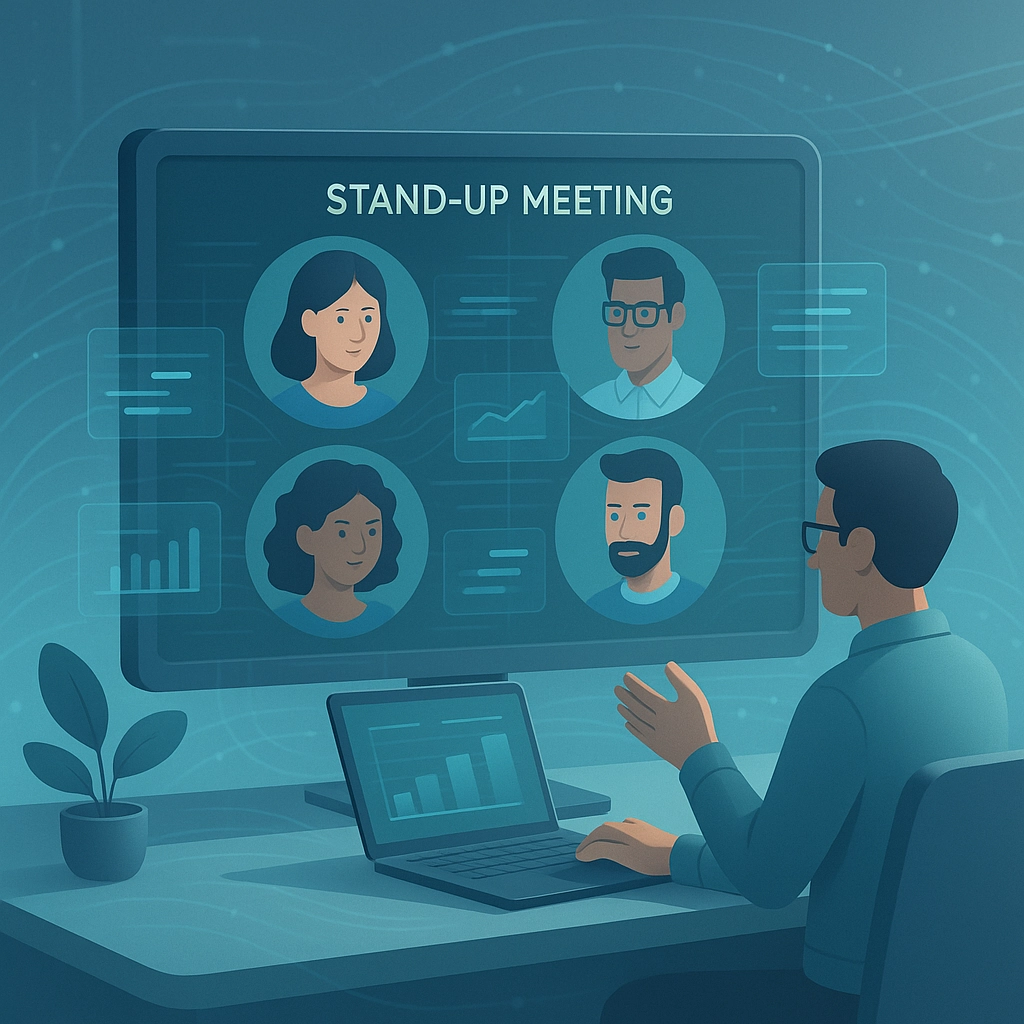
For co-located teams, standing in a circle away from desks reinforces the meeting's temporary nature and fosters equal participation. For remote teams, video is essential—seeing facial expressions and body language dramatically improves communication quality.
Some distributed teams use virtual office platforms that create persistent "standup spaces" where avatars gather, maintaining the spatial metaphor even in digital environments.
Tools to Enhance Your Standups
Technology can elevate standup effectiveness:
For Distributed Teams:
- Slack integrations like Standup Bot or Geekbot collect responses asynchronously
- Trello or Asana dashboards provide visual context for verbal updates
- Miro or MURAL boards capture and organize blockers visually
For Co-Located Teams:
- Timer displays maintain meeting discipline
- Digital Kanban boards provide visual context for verbal updates
- Blocker tracking systems ensure identified obstacles don't get lost
Measuring Standup Success
How do you know if your standups are working? Look for these indicators:
- Meeting creep hasn't occurred (still under 15 minutes)
- Blockers are consistently resolved before the next standup
- Cross-team assistance happens organically following standups
- Information asymmetry between team members decreases
- Surprises in project status become rare
- Team members initiate the standup without management prompting
Beyond the Basics: Evolving Your Standup Practice
Once your team masters the fundamentals, consider these enhancements:
The Fourth Question
Some teams add: "How can I help someone else today?" This proactively identifies collaboration opportunities rather than waiting for someone to request help.
The Weekly Retrospective Standup
Once weekly, replace one standup with a slightly longer session focused on process improvement. Ask: "What about our standup practice could work better?"
The Celebration Moment
End each standup with recognition of one team achievement from the previous day. This builds positive momentum and reinforces the value of sharing successes.
The Team Connection Extension
Consider adding an optional 10-15 minute extension where team members share something about themselves. This personal connection time is particularly valuable for distributed teams who rarely meet face-to-face, helping build relationships across digital divides.
Conclusion: Small Investments, Massive Returns
For small teams, the daily standup represents one of the highest ROI investments available—15 minutes that can save hours of misalignment, duplicated efforts, and delayed problem-solving.
The beauty lies in its adaptability. Your standup practice should evolve with your team, shifting to match your current challenges and workflow. The principles remain consistent: brevity, focus, and action.
The most successful small teams don't view standups as meetings at all, but as a communication framework that happens to include face-to-face time. When implemented thoughtfully, they become the connective tissue that transforms individual contributors into a synchronized team capable of achievements far beyond the sum of its parts.
Comments