Week 1: Beyond Deadlines: Using Project Management Tools to Drive Real Team Accountability
- jeff wilson
- Aug 1, 2025
- 6 min read

Updated: Aug 28, 2025
BLUF (Bottom Line Up Front)
Project management tools do much more than track deadlines—they create the foundation for true team accountability by establishing clear ownership, providing visibility into progress, and facilitating effective communication. When properly implemented, these tools transform the "Plan" and "Do" phases of the PDCA cycle from management directives into team-driven activities. This article explores how to leverage PM tools to build accountability, common pitfalls to avoid, and strategies for overcoming stakeholder resistance.
The Accountability Crisis in Modern Teams
Despite sophisticated project management software and methodologies, many organizations still struggle with accountability. Teams miss deadlines, deliverables fall short of expectations, and finger-pointing becomes the default response to failure. The issue rarely stems from a lack of tools—rather, it's how we're using them.
Most teams use project management tools primarily as glorified to-do lists or management surveillance systems. This limited approach misses the true potential of these platforms: creating an environment where accountability is baked into every interaction, decision, and workflow.
The PDCA Connection: Planning and Doing with Purpose
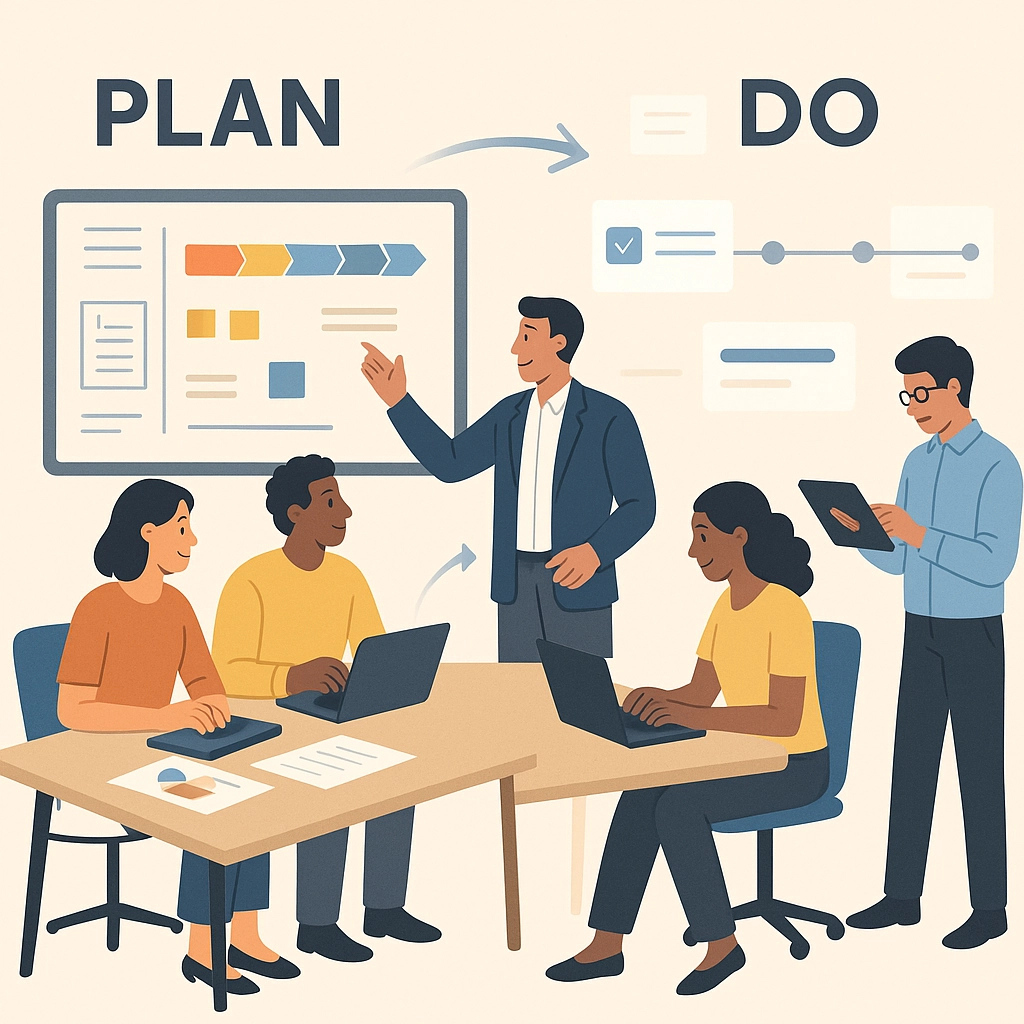
The Deming Cycle (Plan-Do-Check-Act) provides an excellent framework for understanding how project management tools support accountability. This article focuses on the first two phases—Plan and Do—where the foundation for accountability is established.
In the Plan phase, effective project management tools facilitate:
- Collaborative goal setting and strategy development
- Strategic alignment with company objectives and priorities
- Budget planning and financial resource allocation
- Clear role and responsibility assignment
- Realistic timeline creation with team input
- Resource allocation based on capability and capacity
During the Do phase, these tools enable:
- Transparent task execution and progress tracking
- Cost monitoring and expense management against budgets
- Real-time communication about blockers and dependencies
- Documentation of decisions and their rationale
- Adaptation to changing conditions without losing focus
Beyond Assignment: How PM Tools Build True Accountability
True accountability goes far beyond simply assigning tasks to team members. Modern project management platforms build accountability through several key mechanisms:
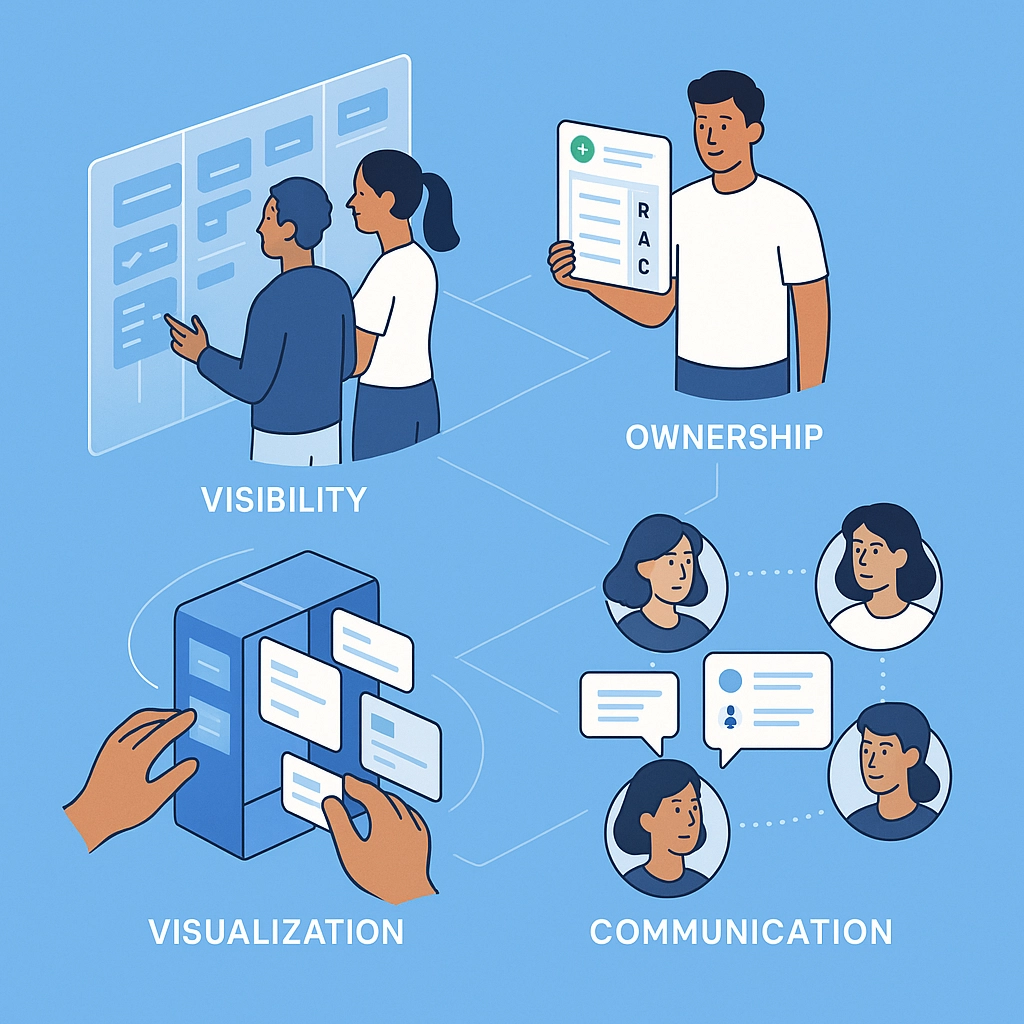
1. Visibility and Transparency
When everyone can see who's responsible for what, when deliverables are due, and how individual work connects to broader objectives, excuses evaporate. Project dashboards serve as the "single source of truth" that eliminates ambiguity and creates shared understanding.
Accountability Feature: Look for tools with customizable dashboards that show both high-level progress and granular task details. This balance ensures everyone from executives to individual contributors can find the information relevant to their responsibilities.
2. Ownership Architecture
The most effective project management tools allow for nuanced ownership definitions beyond simple task assignments.
Clarifying Roles with RACI
RACI matrices (Responsible, Accountable, Consulted, Informed) can be built directly into workflows, clarifying not just who's doing the work, but who has decision authority, who needs to provide input, and who needs to stay in the loop. As detailed in our previous article on setting expectations without micromanaging, this framework prevents confusion and bottlenecks by establishing clear communication channels from the outset.
Accountability Feature: Choose tools that support role-based permissions and multi-level accountability frameworks. This prevents the common problem of tasks being "assigned" but no one feeling truly responsible for outcomes.
3. Progress Visualization
Human brains respond to visual cues. Gantt charts, kanban boards, and burndown charts transform abstract project data into intuitive visuals that make progress (or lack thereof) immediately apparent to everyone. A good, low-tech way to implement this can be as simple as a Kanban whiteboard in the office or shop that is available for everyone on the team to see.
Accountability Feature: Implement visual management tools that automatically update as team members complete tasks. This creates a natural pull toward completion as team members see their contributions directly affect project visuals.
4. Integrated Communication
When communication happens within the project management environment rather than across scattered channels, context is preserved and documentation becomes automatic. This eliminates the "I never got that message" problem that undermines accountability.
Accountability Feature: Select tools that integrate discussion threads, file sharing, and decision logging directly into task and project views. This creates a self-documenting workspace where communication and action are seamlessly connected.
What Can Go Wrong: Common Pitfalls in the Plan & Do Phases
Even with sophisticated tools, several common pitfalls can undermine accountability:
Tool Overload
When teams use too many disconnected tools, information gets fragmented and accountability gaps emerge. One team might track tasks in Asana, another in Jira, while communication happens across Slack, Microsoft Teams, email, and various document platforms.
Solution: Consolidate to a core toolset with strong integrations. It's better to have slightly fewer features in a unified system than perfect features spread across disconnected platforms.
Technology tools are only useful when they are used properly, a technology stack which increases workload on the project team, and creates more process friction, is less effective than no tools at all. Process friction not only hinders project progress but actively demotivates team members and damages long term morale.
Unclear Responsibilities
Even within a single tool, accountability fails when tasks are assigned to multiple people or described too vaguely to enable clear ownership.
Solution: Establish the rule of "one accountable owner" per deliverable, even when multiple team members contribute. Ensure task descriptions include clear success criteria.
Overly Rigid Planning
When project plans are treated as unchangeable contracts rather than adaptive frameworks, teams lose the flexibility to respond to changing conditions—and accountability suffers as a result.
Solution: Build regular plan review sessions into the project workflow. Treat the plan as a living document that evolves as the team learns, while still maintaining clear accountability for outcomes.
Documentation Without Action
Some teams become excellent at documenting tasks and decisions in their project management tools but fail to connect this documentation to meaningful action.
Solution: Implement a "decisions to actions" protocol where every documented decision generates specific, assigned next steps visible in the project workflow.
Overcoming Stakeholder Objections
Resistance to robust project management implementation often comes in predictable forms. Here's how to address the most common objections:
"We don't need another tool"
This objection typically comes from teams already feeling overwhelmed by technology.
Response: Frame the discussion around consolidation rather than addition. Show how a comprehensive project management platform can replace multiple single-purpose tools, reducing overall tech complexity while improving workflow coherence.
"This is just micromanagement in digital form"
Team members may fear that increased visibility means increased surveillance and control.
Response: Demonstrate how proper PM tool implementation actually increases autonomy by clarifying expectations upfront and reducing the need for managerial intervention. When everyone can see progress, managers can step back from day-to-day oversight.
"We don't have time to maintain another system"
This objection highlights concerns about administrative overhead.
Response: Start with a minimal viable implementation focused on the highest-value activities. Show how time spent maintaining the system is recovered through reduced meeting time, fewer status update emails, and elimination of redundant communication.
"Our work is too creative/unpredictable for rigid tools"
Creative and innovation teams often resist structured project management.
Response: Customize views and workflows to match their natural work patterns. Show how even creative work benefits from basic structure around deadlines, dependencies, and resource allocation, while leaving maximum flexibility in execution.
Implementation Guide: From Tools to Accountability Culture
Setting Up Effective Accountability Systems
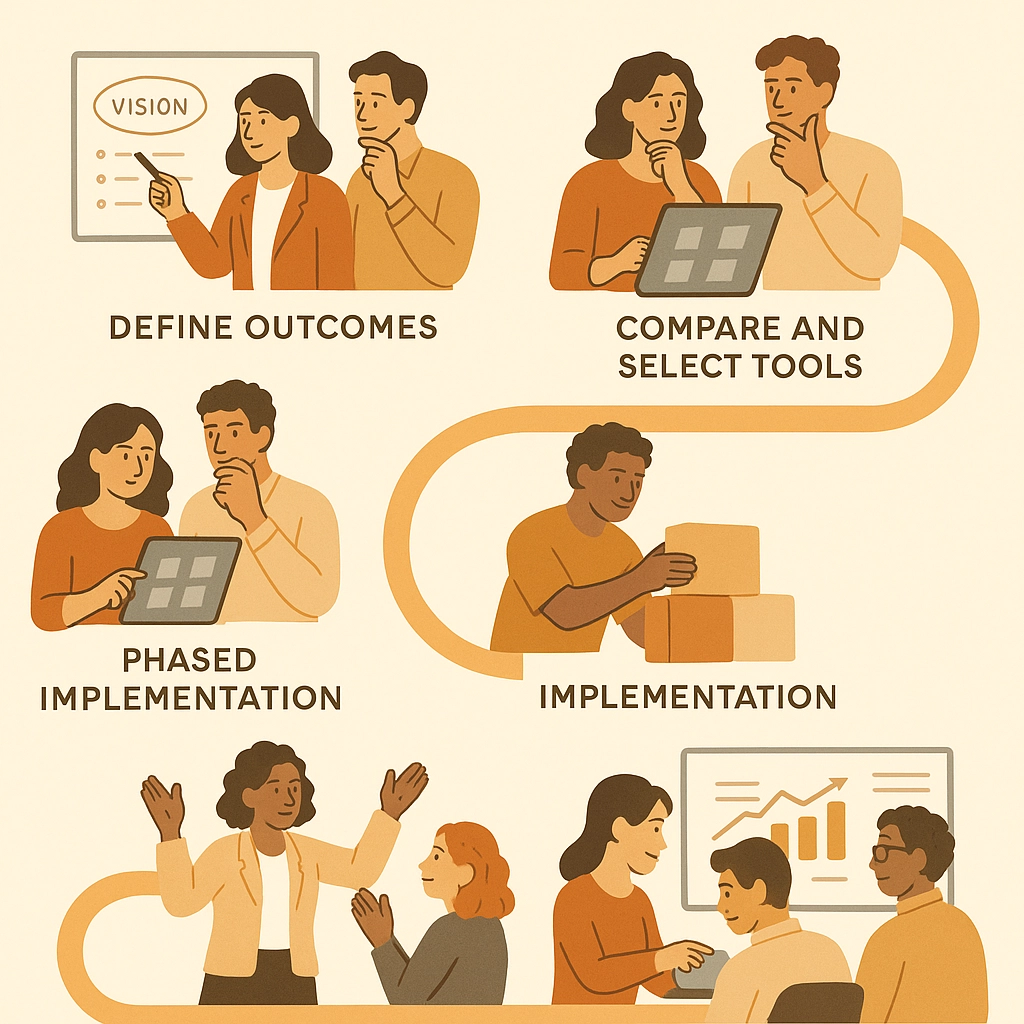
- Start with outcome definition Before selecting or configuring tools, clearly define what "success" looks like for your team. Which accountability problems are you trying to solve? Which metrics will demonstrate improvement?
- Understand actual work processes Involve team members who perform the work in tool selection and workflow design. Tools developed by leaders in isolation often miss critical nuances of how work actually happens, leading to systems that hinder rather than help productivity.
- Select tools that match your workflow The best tool is the one your team will actually use. Prioritize intuitive interfaces and familiar paradigms over feature richness when making your selection.
- Implement in phases Begin with core functionality (task assignment, basic progress tracking) before advancing to more sophisticated features. This creates quick wins that build momentum.
- Create accountability for the system Designate system champions responsible for tool adoption, training, and ongoing refinement. Without clear ownership of the implementation itself, even the best tools will languish.
- Review and adapt regularly Schedule explicit checkpoints to evaluate how the tools are supporting accountability and what adjustments might improve outcomes. This models the continuous improvement mindset essential to long-term success.
Connecting to the Next Step: From Planning to Visualization
As we've explored, effective project management tools create the foundation for accountability during the Plan and Do phases of the PDCA cycle. In next week's article, we'll dive deeper into visualization techniques—specifically how Gantt charts and Kanban boards bring complex projects to life and sustain team momentum through the Do phase.
We'll explore how these visual tools move teams from abstract planning to concrete action, maintaining the thread of accountability through elegant visualization of progress, dependencies, and bottlenecks.
The Bottom Line
Project management tools only drive accountability when they're implemented with deliberate attention to ownership, visibility, and communication. By avoiding common pitfalls and addressing stakeholder concerns proactively, teams can transform these platforms from simple task trackers into powerful accountability engines that support both the Plan and Do phases of continuous improvement.
The goal isn't surveillance or control—it's creating an environment where responsibility is clear, progress is visible, and success is shared. When properly implemented, project management tools don't impose accountability; they enable it to emerge naturally from collaborative work toward shared goals.
This is part one of our four-part series on Project Management Tools & Methods through the PDCA Lens.Join us next weekas we explore how visual management tools drive execution in the Do phase of the improvement cycle.

Comments