Week 3: The Value of Retrospectives—Turning Project Reviews Into Lasting Improvement
- jeff wilson
- Aug 28, 2025
- 4 min read

BLUF: Retrospectives transform routine project reviews into engines of ongoing improvement. By reflecting, discussing, and acting on what works and what doesn’t, teams drive engagement, learn faster, and adapt smarter, setting the stage for sustainable results across business functions.
Issue: The Problem with “One-and-Done” Project Culture
In many organizations, projects wrap up with little more than a perfunctory “lessons learned” meeting—if any review happens at all. Teams quickly move on to the next objective, repeating cycles of trial and error and missing out on hard-won insights. This “one-and-done” mindset means opportunities for improvement, innovation, and collaboration are left on the table.
What’s missing is a space for teams to pause together, reflect honestly, and extract actionable lessons. Without this, organizations risk:
Repeating the same mistakes across projects
Eroding team morale by missing chances to recognize success
Missing early warning signs of process breakdowns
Fostering a blame-focused, rather than growth-focused, culture
Why Most “Lessons Learned” Don’t Stick
Ad hoc debriefs or documentation-heavy project post-mortems often turn into check-the-box activities. Insights gathered may sit in a folder, never to be seen again, and—crucially—are rarely translated into real-world changes in behavior or process.

Resolution: The Retrospective Framework—How Structured Reflection Drives Real Change
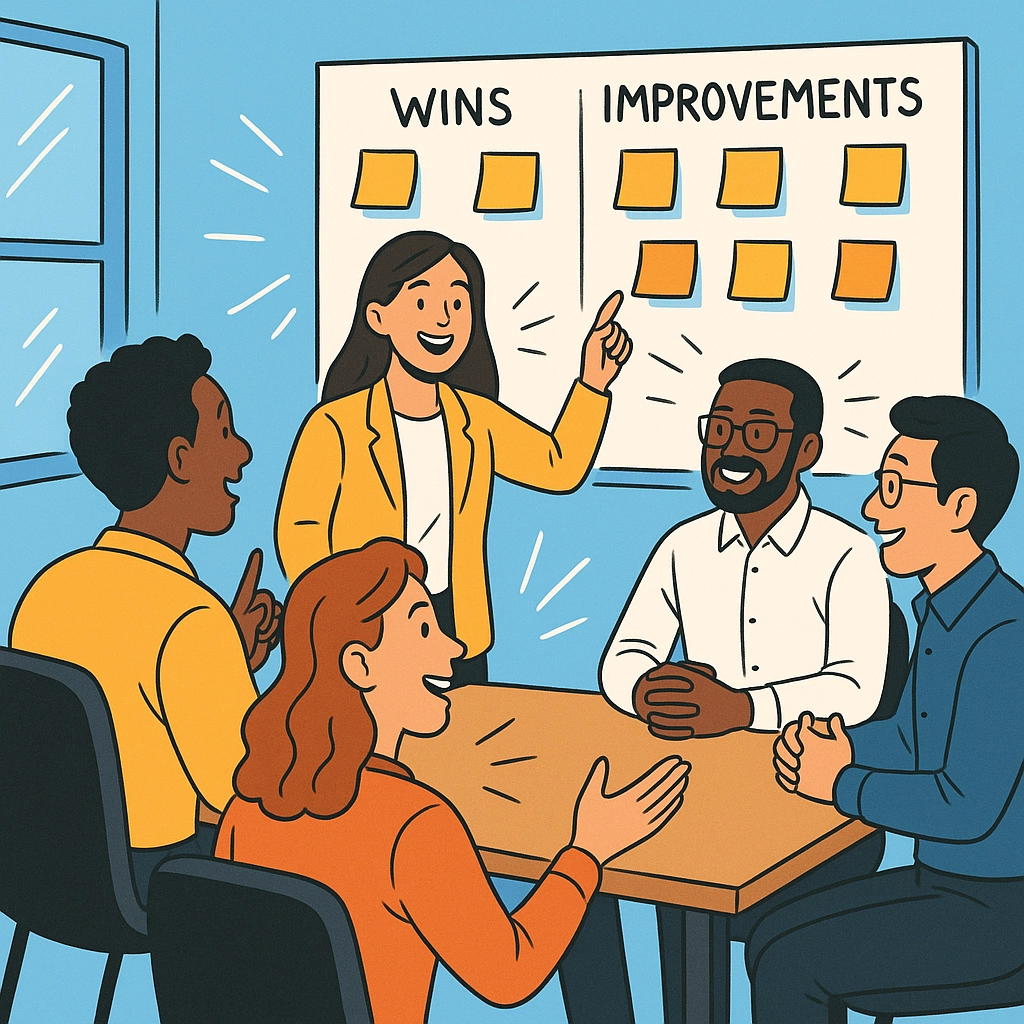
Retrospectives flip the script. They’re regular, structured meetings designed for teams to look back on a completed project (or project phase), celebrate wins, candidly discuss what didn’t go so well, and agree on clear actions for the future.
What is a Project Retrospective?
A retrospective is a collaborative review session that empowers everyone on the team to share their perspectives. It typically centers around three key questions:
What went well?
What could have gone better?
What concrete actions can we take to improve next time?
This format encourages participation, psychological safety, and—most importantly—turns feedback into “actionable team learning.”
Benefits That Compound Over Time
Enhanced Engagement: Teams that regularly reflect feel more connected to both their work and one another. Celebrating successes together boosts morale, energy, and buy-in.
Increased Transparency and Trust: Openly sharing failures and frustrations—without finger-pointing—builds mutual trust and strengthens communication.
Continuous Process Improvement: Problems and inefficiencies are identified and addressed rapidly, before they become ingrained or multiply.
Deeper Organizational Learning: Instead of isolated insights, knowledge is shared and embedded in new standard practices.
The Research Backing It Up
A notable joint study—by the Wharton School, Cornell, and the University of Colorado—demonstrated that “prospective hindsight,” the process of reflecting as if an outcome has already occurred, boosts the ability to predict future project risks and obstacles by 30%. Source This shows that structured retrospectives aren’t just feel-good exercises—they tangibly improve project outcomes and decision-making.
Implementation: Making Retrospectives Stick
Getting retrospective value depends less on the tool and more on ritual, consistency, and psychological safety. Here’s how teams can make retrospectives a cornerstone of continuous improvement:
Pick the Right Cadence
Retrospectives are at their best when held regularly—not just at the end of big projects. They work just as well after major milestones, sprints, campaigns, or even after significant customer engagements.
Typical cadence: Every 2–4 weeks in Agile environments; at minimum, after project completion elsewhere.
Foster an Open, Blame-Free Atmosphere
The goal is collaborative improvement, not fault-finding. Invite all voices, use facilitators when needed, and emphasize that failure is a learning opportunity.
Go Beyond Talking—Make Actions Explicit
Each retrospective should end with a handful of concrete, owner-assigned actions. Things like:
“Let’s switch to daily 10-minute stand-ups before noon”
“We need a shared doc for customer feedback—Jane to create it”
“Our review process is taking too long; trial a simplified checklist on the next campaign”
Track these actions in follow-up meetings to close the loop.
Share and Scale Learning
Record and distribute key learnings—both wins and course corrections—not just within the project team, but across other units that could benefit.
For inspiration on simplifying this process and driving accountability, see Beyond Deadlines: Using Project Management Tools to Drive Real Team Accountability.

Expanding the Value of Retrospectives Across the Business
While rooted in Agile software development, retrospectives deliver benefits to a range of business disciplines:
Project Management: Ensuring project processes become sharper with each iteration Product Development: Capturing what delights (or frustrates) customers and acting on it Marketing: Reviewing campaign effectiveness and pivoting quickly Customer Service: Continuously improving responsiveness and client satisfaction Leadership & Team Development: Building cultures centered on transparency, empathy, and growth
Explore more ways projects, leadership, and team productivity intersect at Team Productivity Insights or Leadership Insights.
Best Practices for Successful Retrospectives
Keep it routine: Don’t skip—make them as regular as status updates.
Limit scope: Focus on a clear period or milestone to avoid overwhelm.
Rotate facilitators: Build ownership and fresh perspectives.
Celebrate progress: Publicly recognize improvements made as a result of retros.
The Payoff: A Culture of Continuous, Team-Led Improvement
When embedded in organizational rhythm, retrospectives:
Surface and solve issues early before they block bigger progress
Strengthen team morale, engagement, and retention
Reinforce a growth mindset and willingness to experiment
Cement learning through explicit action—not just discussion
Retrospectives help turn the end of the project into the start of something even better. By making reflection and improvement everyone’s business, organizations build resilience, agility, and lasting momentum.
For more actionable strategies on building purposeful, high-performing teams, check out Using Feedback Effectively to Build Trustful Small Teams and stay tuned for next week’s article in the series.
Comments